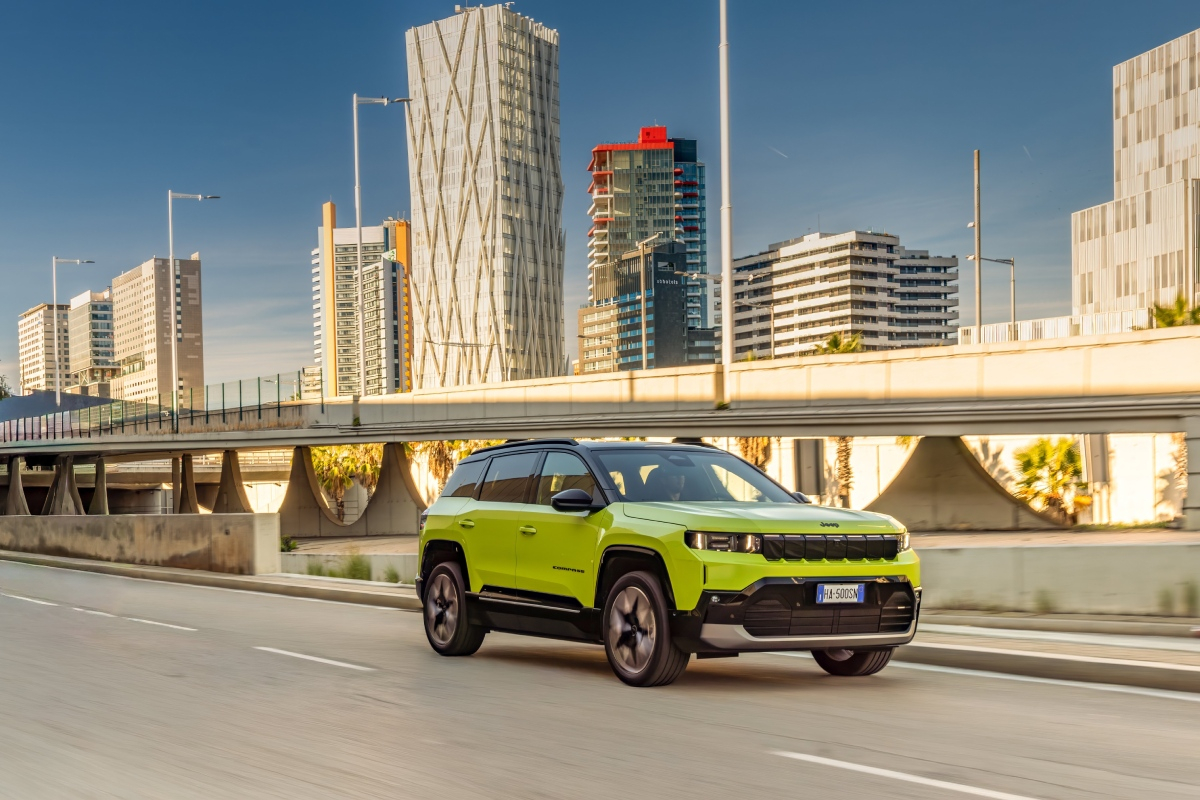
Why we love it:
- It’s stylish
- Iconic brand image
- Competitively priced
Where it could be better:
- It could be more memorable to drive
- More premium materials, please!
- Could we have a ‘frunk’ in the electric version?
Introduction
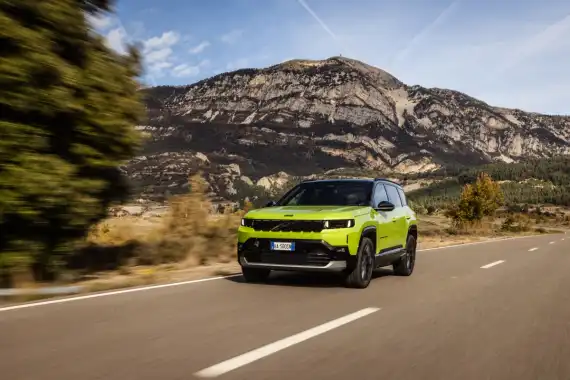
The Jeep Compass has established itself as a notable success story for the brand, boasting over 2.5 million sales worldwide, writes motoring journalist Tim Barnes-Clay.
The latest iteration of this compact SUV harmoniously combines attractive design with a variety of powertrains to suit diverse preferences, including mild hybrid, plug-in hybrid, and fully electric options - the latter being a first for the Compass.
Now in its third generation, the Jeep Compass is entirely new, constructed on Stellantis' STLA Medium platform, which serves as a foundation for vehicles across different marques within the global automotive group in the compact and midsize categories. Consider models like the Peugeot E-3008 and E-5008, as well as the Vauxhall Grandland. In this review, we delve into the electric version of the Compass, which we had the opportunity to test drive at its launch.
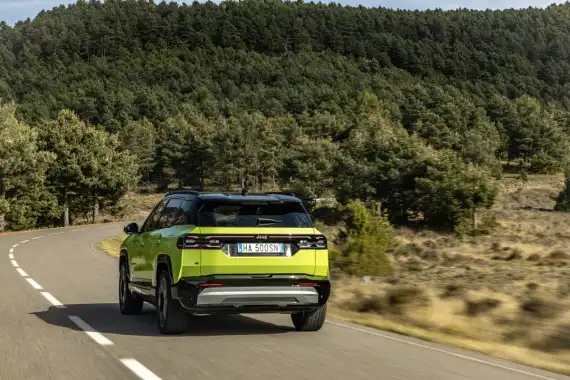
From a design perspective, distinguishing the electric Compass from its hybrid counterparts can prove to be a bit of a challenge. However, if you channel your inner Sherlock Holmes, you might notice a subtle 'e' badge on the back of the Jeep - this small detail is really the only giveaway until you take it for a spin, of course.
On The Road
Handling & Performance
The electric version we’re testing accelerates from 0 to 62mph in 8.5 seconds, which is quite respectable – and, naturally, the more powerful variants are likely to improve on that figure.
In comparison, the e-Hybrid’s time of 10.3 seconds feels rather sluggish and seems to lose its vigour quickly, despite weighing well over half a tonne less than the electric model we’re concentrating on.
The e-Hybrid's gearbox isn't particularly smooth either, and initial acceleration feels laboured at speeds above 20 or 30mph. However, it doesn't screech at higher revs as much as some competitors, so it's not all bad news.
However, our electric model in First Edition trim appears unaffected, offering punchy acceleration in generous amounts as soon as you press the throttle – it easily reaches motorway speeds and accelerates well for overtaking.
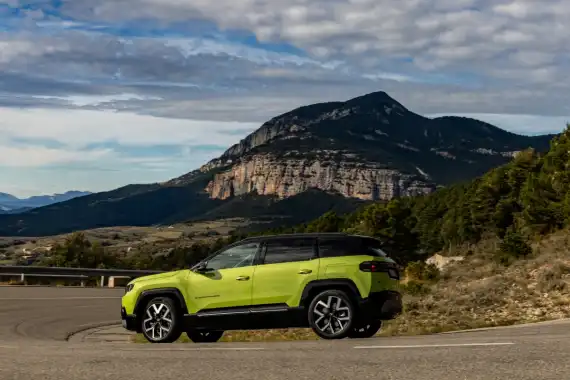
Handling isn’t exactly a priority for a Jeep, and the steering reflects that. The wheel is very light, doesn’t firm up much around corners, and provides little in terms of feel or feedback, leaving you with no real sense of connection to the front wheels.
That said, it is accurate and reassuring at most speeds, with a decent level of grip through bends, although the tyres feel somewhat overwhelmed when pushed.
Body roll is just what you’d expect from an SUV of this kind, but Jeeps are designed to feel robust and substantial. Keeping that in mind, it delivers on that front and is thus enjoyable in its own unique way.
Our electric version feels slightly softer than the e-Hybrid. In fact, it seems to handle a wider variety of road surfaces competently compared with the e-Hybrid.
Of course, there are some features that nod towards off-roading, with various traction settings designed for mud and snow, but this remains a vehicle built primarily for the road.
Should you wish to take it off-road, its approach angle is 20 degrees, and its departure angle is 26 degrees – the former figure may limit the difficulty of the off-road terrain it can tackle.
Regenerative braking is offered in four modes – three that adjust the intensity based on your selection, and one adaptive mode – though it’s not the most intuitive regen system we’ve encountered in terms of getting accustomed to it. The adjustment is made by pulling the paddles behind the steering wheel.
Styling
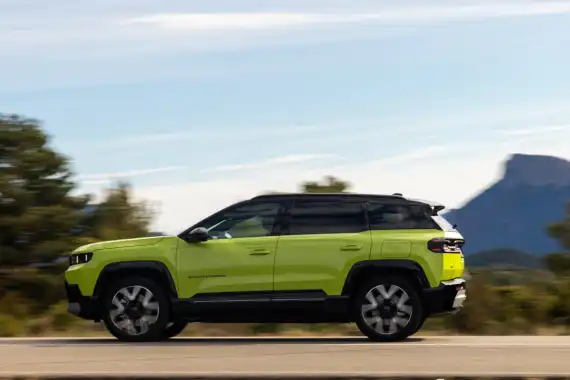
The new Compass maintains a resemblance to its predecessor but is noticeably distinct.
The iconic seven-slot grille remains, albeit constructed from panels on the new version – and they illuminate – yet it still exudes the same essence we’ve come to associate with the Compass over the years.
Lower down, black cladding covers half the front end and extends around the sides, featuring almost straight-edged wheel arches, robust side skirts, and a couple of pronounced creases in the doors.
At the rear, the taillights are straighter than before, with a light bar running the entire length of the tailgate, just above the number plate, while lower down there's more substantial cladding.
It still looks tough and commands presence, but the Jeep appears more athletic and less bulky than before. Think less flab, more muscle – it seems the Compass has been hitting the gym.
At launch, there are two trim levels available for the latest Jeep Compass.
The entry-level Altitude features 19-inch alloy wheels, a 16-inch infotainment touchscreen with Apple CarPlay and Android Auto, digital radio, a 10.25-inch digital instrument display, and keyless entry and start. You also receive power-folding door mirrors, automatic LED headlights, cloth seats, dual-zone climate control, ambient lighting, and two-way lumbar support. Front and rear parking sensors, along with a range of safety systems, are included as standard.
The range-topping First Edition boasts larger 20-inch alloy wheels, LED matrix headlights, front fog lights, privacy glass, satellite navigation, a wireless phone charger, a powered tailgate, cloth and vinyl heated seats, and a heated steering wheel. Enhanced ambient lighting, a rear-view camera, and an alarm are also part of the package.
All electric versions come with cabin pre-conditioning (allowing you to warm the interior before you get in) and a heat pump, which helps to heat the cabin without consuming too much battery power.
Currently, there is a mild-hybrid (MHEV) variant known as the e-Hybrid, alongside a fully electric version. The e-Hybrid is equipped with a 1.2-litre three-cylinder petrol engine producing 145PS, paired with a six-speed dual-clutch automatic transmission.
There will be three electric variants available, although only the front-wheel drive model, generating 213PS, can be ordered at present. A longer-range model with an output of around 231PS and a dual-motor all-wheel drive variant reaching about 375PS will follow at a later date.
A plug-in hybrid (PHEV) model is also in development, featuring a 1.6-litre four-cylinder petrol engine combined with an electric motor to produce approximately 195PS.
Space & Practicality
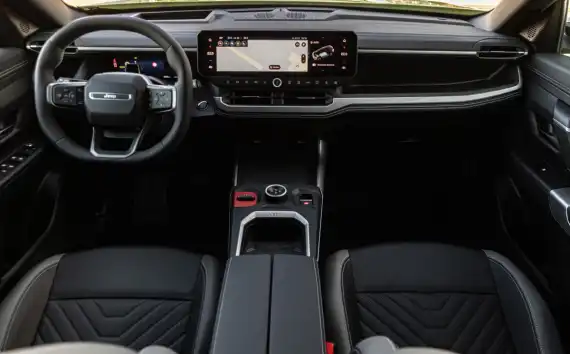
The interior of the Jeep Compass is far from rugged in appearance. Instead, it boasts a modern and stylish design, featuring a chunky, flat-bottomed steering wheel and ample silver trim that breaks up the otherwise monotonous dark colour scheme.
There is a convenient rotary drive selector located on the centre console, and the cabin is adorned with a variety of soft-touch, plush materials, along with wipe-clean rubber floor mats. Even the seat upholstery is designed for easy maintenance.
In all honesty, while the interior is quite pleasant, there's little to indicate that you’re in a Jeep, apart from the prominent badge in the centre of the wheel.
However, upon closer inspection, you may spot nods to the brand’s heritage, including elements reminiscent of the classic Willys Jeep.
Unfortunately, further scrutiny also reveals that many of the materials used aren’t as high-quality as they appear, with some cheaper, thinner plastics found in certain areas, particularly lower down.
Under Stellantis, Jeep inevitably incorporates parts from Peugeots and Fiats across multiple brands, including this model. Yet, as a brand positioned as a premium SUV manufacturer, the presence of subpar materials in some places is disappointing.
The coolest feature, however, is the enormous infotainment touchscreen. At 16.0 inches, it ranks among the largest displays in any vehicle, complete with a customisable home screen for your frequently used shortcuts. It also includes haptic touch buttons underneath.
The display is remarkably clear, and the interface is user-friendly. The touchscreen responds reasonably swiftly to inputs, though the menu layout isn’t particularly intuitive, and some icons can be tricky to hit while driving.
Furthermore, the air conditioning controls are tucked away within the touchscreen, making it somewhat challenging to adjust the temperature while on the move.
That said, the temperature settings remain visible no matter which menu you’re using, so you don’t have to sift through multiple screens to find them.
The 10.25-inch digital instrument display behind the steering wheel is also impressively clear, though it doesn’t offer as much customisability as some competitors.
Overall, while the interior is visually appealing, the more time you spend inside the cabin, the more likely you are to notice the flaws that detract from its image as a premium offering.
Finding a comfy driving position is simple, thanks to the electric front seat adjustment featured in our test vehicle, although it is part of an optional extra pack.
This pack also includes a massage function, which is quite pleasant when in use, but it does make the seats slightly less comfortable when not activated.
That said, there’s a decent amount of legroom and headroom inside, and the cabin is sufficiently wide to accommodate two front occupants without competing for shoulder space.
In the back, there’s reasonable headroom and enough legroom for adults, although taller individuals may feel a bit cramped. Under-thigh support is lacking, and the floor sits relatively high.
Forward visibility is good, aided by a relatively elevated driving position and thin windscreen pillars, which enhance your view at junctions.
At the rear, the tapering side windows don’t extend far back, resulting in very thick pillars that, combined with the sloping roofline, restrict over-the-shoulder visibility.
Nonetheless, all Compasses come equipped with front and rear parking sensors, and the First Edition model we’re testing features a rear-view camera as well.
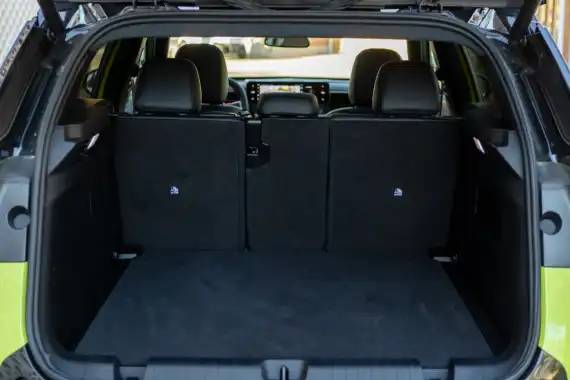
In terms of practicality, both the Electric and eHybrid models offer 550 litres of boot space, which expands to 1,695 litres with the rear seats folded down in a 40:20:40 split.
There is also a significant amount of underfloor storage available, although there isn’t a ‘frunk’ space under the bonnet, as found in some electric vehicles.
The cabin boasts ample storage space too - apparently 34 litres, according to Jeep, which is more than double that of the previous Compass model.
It features large door bins and a sizeable cubby beneath the central armrest, along with charging ports and cupholders.
Ownership
Running Costs
The electric Compass can charge at a maximum rate of 160kW DC. This means that a 10-80% top-up takes 31 minutes with the smaller battery.
Home charging at 11kW AC is possible, with an upgrade option available to 22kW, although it’s important to note that many homes may not support these speeds.
A 7kW home wallbox is more typical, taking just under 12 hours for the smaller battery to reach a 0-100% charge.
Of course, the electric version has no emissions and no MPG figure – it’ll be very cost-effective to run, especially if you can charge it at home. It’s also the ideal choice if you’re looking for a company car, thanks to its low Benefit in Kind tax rate.
The e-Hybrid achieves 47.8mpg and emits 133g/km of CO2, which is quite reasonable.
We do not yet have the figures for the upcoming PHEV, but it’s expected to be significantly more economical than the e-Hybrid.
Verdict
Overall, the all-new Jeep Compass represents a significant improvement over its predecessor.
It boasts contemporary aesthetics, a pleasing interior, a large infotainment screen, and an abundance of standard features.
Furthermore, it’s competitively priced for its size, with several smaller rivals in a similar price bracket, meaning you’ll receive more practicality for your money as well.
However, the Compass doesn’t offer anything that distinctly sets it apart from the competition, and particularly in terms of driving dynamics, it lacks the unique features that would make it more appealing than any other Stellantis vehicle.
While it does possess a rugged character that surpasses that of other SUVs, the reality is that most drivers won’t require that capability unless they regularly navigate a dirt track to reach the main road.
It is easy to drive, but rather forgettable - and although the interior is lovely, it does feature some materials that undermine Jeep’s claim to being a premium product.
All things considered, it’s a solid choice to buy, but brands like Kia provide even greater refinement along with similar levels of equipment.