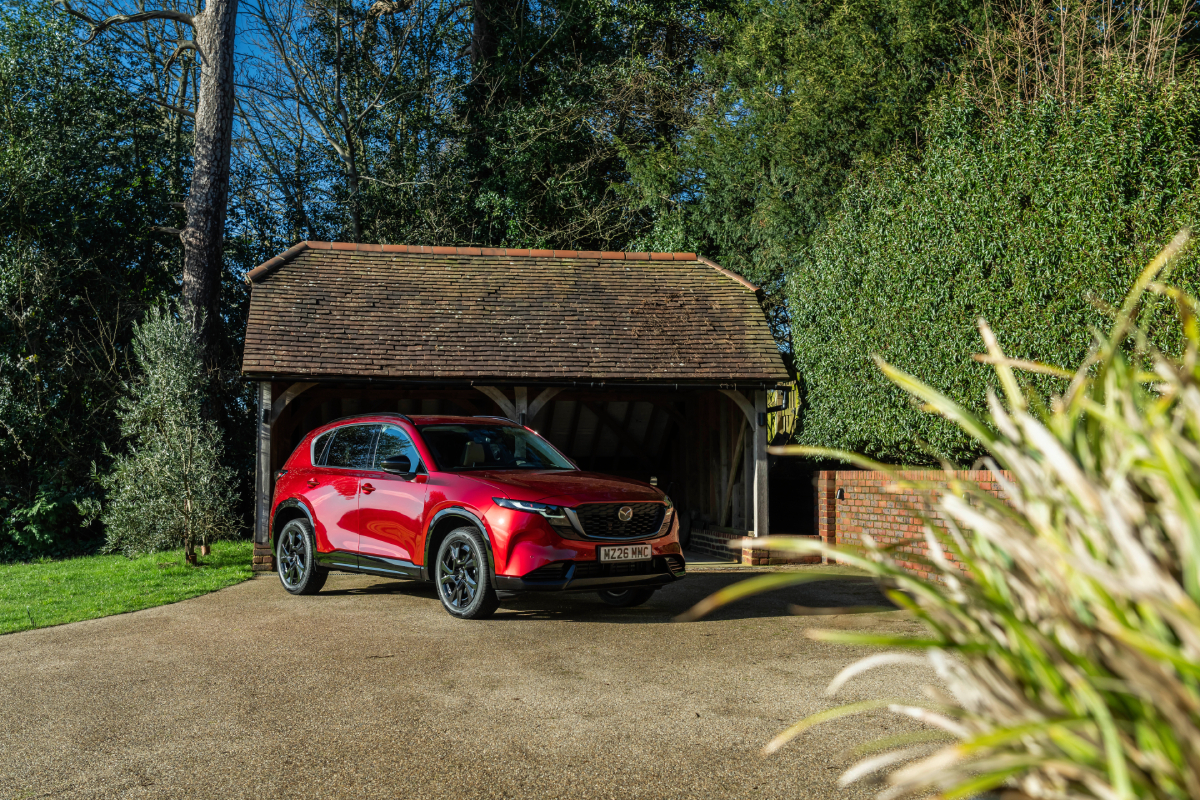
Why we love it:
- Practical and roomy
- Handles well for a big car
- Good value for money
Where it could be better:
- The engine could have more grunt
- Ride comfort could be even better
- More physical controls in the cabin would be appreciated
Introduction
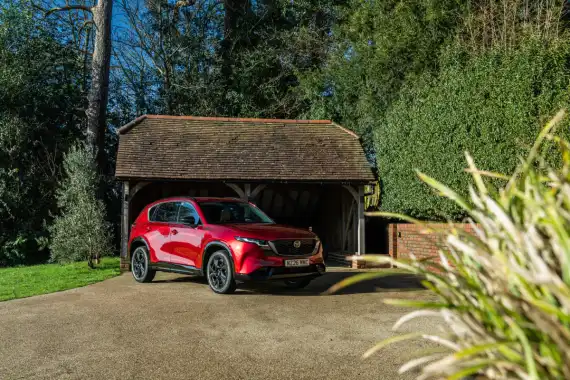
Mazda has always prided itself on its unique approach to automotive design.
At a time when manufacturers were favouring compact engines over hybrid solutions, the Japanese automaker introduced the CX-60, featuring a robust 3.3-litre V6 diesel lump.
The logic behind the decision was simple: to increase engine size by using technology that would enable it to turn off unnecessary cylinders, thus improving performance and efficiency.
Fast-forward just over three years, and this mill remains part of Mazda's offerings.
While it's absent from the model we're evaluating today, the engine fitted is still larger than one you’d typically encounter in most contemporary family vehicles.
The CX-5 debuted in 2012, with a significant upgrade arriving just four years later in the form of its second-generation model.
Having outlasted the original by double the time, the wait is over as the third-generation makes its entrance, boasting increased dimensions across nearly every metric.
With this growth, we anticipate enhanced practicality, a more spacious boot, commendable performance, and, true to Mazda’s reputation, unexpectedly excellent handling from a marque often underrated.
Mazda interiors are typically quite sophisticated, yet the recent updates to the new CX-5 leave us a bit apprehensive about what to expect.
Does it still possess the enchanting essence of Mazda?
Our motoring journalist Tim Barnes-Clay attended the UK media launch of the 2026 CX-5 to find out.
On The Road
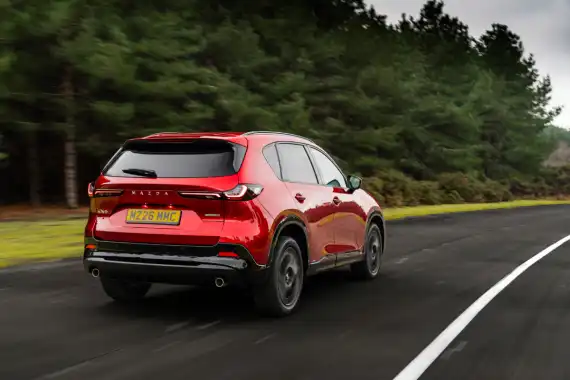
Handling & Performance
We are exploring the extremes of the range, taking the front-wheel drive Prime-Line and Homura variants for a test drive. With only one engine option available for the CX-5, we expect minimal variance in their driving characteristics.
In our front-wheel drive test model, the 0 to 62mph sprint is completed in 10.5 seconds, which feels rather sluggish for a sizeable petrol unit in today's context. The four-wheel drive variant takes even longer, clocking in at 10.9 seconds.
It’s somewhat disappointing that there aren’t any more substantial hybrid models available - the current engine is merely a mild hybrid (MHEV) - though Mazda has indicated that a full hybrid (HEV) will be added to the lineup soon.
The lump does require a fair amount of effort to unleash any notable performance, which is counterproductive given its relatively large size, but it does reflect its detuned nature.
On the whole, the driving experience is quiet and refined during regular cruising, but under hard acceleration, the engine can sound a bit raucous.
The Mazda doesn’t feel as though it’s straining for speed; however, it does come across as a tad flat, particularly when compared with the substantial low-end thump offered by electrified and hybrid vehicles these days.
While the CX-5 performs better at a steady 70mph, it takes its time getting there, though it can deactivate half of its four cylinders for improved fuel efficiency.
The six-speed automatic gearbox operates smoothly, with seamless gear changes and a responsive kickdown that provides minimal lag when you need quick acceleration. However, upshifts tend to be a touch lengthy, and as previously noted, the acceleration process can feel drawn out.
If you’re not familiar with Mazda’s typical traits, you may be surprised to learn that handling is one of its cars' key strengths. Despite being a fairly substantial SUV, the CX-5 corners surprisingly well.
There’s ample grip, and the steering responds nicely, feeling well-weighted with plenty of front-end bite.
Granted, it's far from sports-car standards, and premium brands are likely to outshine it in this regard. Additionally, Mazda has made the steering slightly lighter, enhancing ease of use in urban settings while sacrificing some handling finesse.
Nonetheless, if you’re in search of a practical, reasonably priced family SUV that still provides a bit of driving enjoyment, few alternatives can rival this one.
Typically, superior handling tends to affect ride comfort, and this case is no exception. However, Mazda has installed softer springs in response to previous criticisms that it prioritised the driving experience too heavily for a family-oriented vehicle.
The suspension remains relatively firm, though, leading to a somewhat jarring experience on poor road surfaces, where it tends to bounce over potholes and jolts over bumps. On well-maintained roads, however, it feels very stable.
The car’s sound insulation is commendable, effectively minimising wind and road noise.
Since it isn’t a plug-in hybrid or electric vehicle, regenerative braking isn't present; however, the new brake-by-wire system feels reliable and intuitive.
Styling
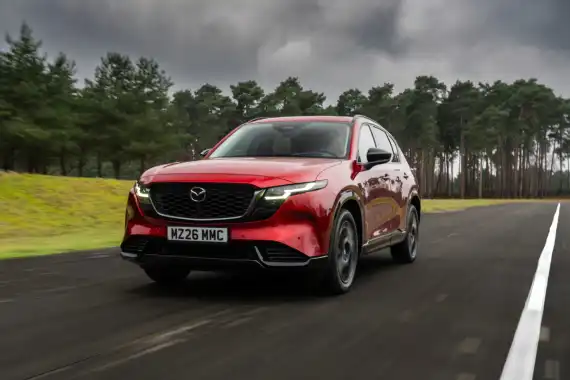
The Mazda CX-5 presents a bold and sophisticated appearance.
Its proportions seem improved compared with its predecessor; the previous front end, which could appear somewhat awkward from certain angles, now exudes much greater confidence.
The updated front design has a less droopy aesthetic, featuring a straighter bonnet that slopes downwards less dramatically, giving the CX-5 a more commanding presence.
The large grille, similar in shape to the earlier model, is now framed by a deep black indentation that curves upwards along the grille’s sides and integrates seamlessly with the more assertive headlights.
Below the grille, there is ample blank space, complemented by two subtle air intakes positioned at the bottom corners.
Moving to the sides, the bodywork is predominantly smooth, with a gentle crease running towards the bottom of the doors, while cladding lines the entire lower section of the vehicle.
This cladding becomes more pronounced towards the rear, where the Mazda name is elegantly displayed in uppercase letters, nestled between slim taillights on either side.
The number plate is situated within a recessed area in the centre of the tailgate.
Although the Japanese car may not be the most intimidating vehicle on the road, it certainly vaunts a more appealing look than before - bolder, more self-assured - yet still suitable for family use.
The 2026 CX-5 is available in four different trim levels. The entry-level Prime-Line features 17-inch alloy wheels, a 12.9-inch infotainment touchscreen with a Google-based interface, DAB radio, wired Apple CarPlay/Android Auto, and a 10.25-inch digital instrument display.
Additional standard equipment includes dual-zone climate control, premium black cloth seat upholstery, LED headlights, and a rear-view camera.
Moving up the range, the Centre-Line trim adds 19-inch alloy wheels, artificial leather and suede-like seat upholstery, smart keyless entry, an electrically adjustable driver's seat with lumbar support, and a powered tailgate.
You’ll also find a head-up display, a heated leather-wrapped steering wheel, and wireless Apple CarPlay/Android Auto connectivity.
The Exclusive-Line comes equipped with a 12-speaker Bose surround sound system and a 360-degree view monitor, which includes front, rear, and side-facing cameras to create a 'see-through' effect.
At the top of the line is the Homura trim, which boasts all-black leather upholstery, adaptive LED headlights, a larger 15.6-inch infotainment touchscreen, seven-colour ambient interior lighting, and a hands-free powered tailgate.
Currently, the CX-5 offers only one engine option: a mild hybrid (MHEV) that’s a 2.5-litre four-cylinder petrol unit known as the eSkyActive-G 141.
Despite its capacity, it produces 141PS of power and is paired with a six-speed auto transmission.
The Prime-Line and Centre-Line trims are available exclusively with front-wheel drive, while the Exclusive-Line and Homura trims offer the option of all-wheel drive.
There is no manual transmission or diesel option available at present, and there are no plans to reintroduce either.
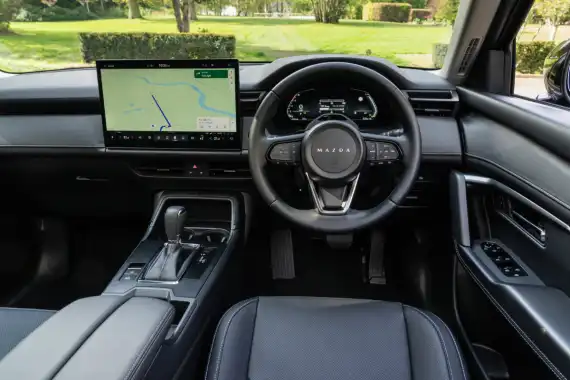
There’s no doubt the interior of the Mazda CX-5 exudes a sense of sophistication, particularly in our Homura trim. It showcases a dual-tone cabin, with the seats, centre console, and the lower section of the dashboard enveloped in a rich ‘tan’ hue.
Except for the Prime-Line model, all variants offer the option of a lighter colour at no extra cost, while every version has silver accents around the gear lever and on the double spokes at the base of the steering wheel.
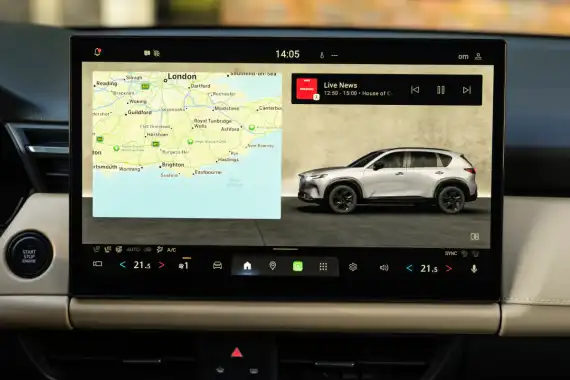
The infotainment display is equally refined, featuring an almost bezel-less design that resembles a tablet seamlessly integrated into the dashboard – it measures 12.9 inches in all models, except for our top-tier Homura, which includes a more expansive 15.6-inch touchscreen.
However, one downside is that the materials don’t seem to match the high quality of the previous generation, with a greater number of hard surfaces than before.
Nonetheless, the aesthetic appeal is undeniable, although the luxury offered by traditional German premium brands still sets a higher standard.
The build quality remains impressively solid, with everything feeling securely assembled.
The infotainment system is enjoyable to use, featuring a responsive interface and crisp graphics that convey a premium feel, as it operates on a Google Android platform.
This allows for native access to applications like Google Maps for navigation.
On the downside, Mazda has eliminated all the physical controls that were present in the previous CX-5 model, including the rotary dial that let you navigate the infotainment screen without direct contact.
As it stands, you are now obliged to use the touchscreen, which doesn’t respond to finger inputs while the vehicle is in motion.
Furthermore, the air conditioning controls, which previously remained off the touchscreen, have been incorporated into it instead.
Adding to the frustration, some of the climate control buttons displayed on the screen are quite small and difficult to operate accurately when driving.
This represents a step backwards regarding usability, all in pursuit of a more streamlined cabin look.
At least the virtual buttons for adjusting the temperature are consistently visible.
Space & Practicality
The Mazda CX-5 presents a suitably elevated driving position.
This provides an excellent view of the road ahead, and the relatively slim front windscreen pillars enhance visibility when approaching T-junctions.
However, the pillars at the rear are considerably thicker, and together with the unique boomerang shape of the back side windows and the support for the roof spoiler, they limit rear visibility.
Fortunately, all models come equipped with parking sensors, along with a rear-view camera; the top two trims even feature a comprehensive 360-degree surround-view camera.
You'll find powered adjustment for the driver's seat, except if you choose our entry-level Prime-Line variant.
Inside the CX-5, you'll discover ample space at the front, as it has been extended by 115mm in length, widened by 15mm, and raised by 20mm compared with the retiring model.
This translates to generous headroom and legroom, with a cabin spacious enough to eliminate any competition for elbow room.
The rear seats benefit as well, with added legroom allowing adults to stretch their pins comfortably, and the modest slope of the roofline ensures that rear passengers won’t feel cramped for headroom.
While fitting three adults in the back can be a bit tight, it is nonetheless manageable.
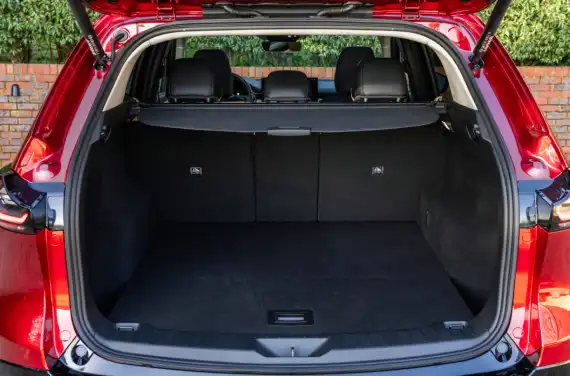
The boot has also seen an increase, now offering 583 litres of capacity, which is a gain of 61 litres over its predecessor.
With the rear seats folded down in a practical 40:20:40 configuration, the capacity expands dramatically to an impressive 2,019 litres - an increase of 381 litres from the old model.
The seats can be collapsed with a simple pull of a lever, although the rear bench doesn’t slide forward or backwards.
One benefit of opting for a lower trim is the additional 30 litres of underfloor storage, which is lost in the top two grades due to the installation of the Bose premium sound system in that space instead.
Ownership
Running Costs
The fresh CX-5 offers a fuel efficiency of 40.4 miles per gallon, which is commendable for a 2.5-litre petrol engine; however, this drops to 37.7mpg for the all-wheel drive versions.
It emits 159g/km of CO2, increasing to 169g/km for the all-wheel drive models.
As a result, the initial road tax for the first year amounts to £1,410, then reverts to the standard annual fee of £200 (subject to yearly adjustments).
Although the core price of the CX-5 is below £40,000, it is important to mention that the all-wheel drive variant in Homura trim is an exception and will incur the £440-a-year Expensive Car Supplement from the second to the sixth year inclusive.
Without any plug-in hybrid options, it may not be the most appealing choice for company car buyers, particularly since PHEVs, and especially EVs, tend to benefit from lower Benefit-in-Kind tax rates.
Mazda generally ranks as an average brand in terms of reliability; however, the previous CX-5 performed better than other vehicles in the firm’s lineup, and it remains to be seen if the new model upholds this reputation.
Additionally, a six-year, 100,000-mile warranty is available, demonstrating Mazda's confidence in the 2026 CX-5.
Verdict
Despite certain limitations, the newest CX-5 remains a great motor for people looking for something decent without emptying their bank account.
Inside, the Mazda maintains an elegant appearance, but the elimination of physical controls is quite disappointing; the outstanding Google infotainment system loses some of its appeal by being confined to the touchscreen, and the interior materials seem to have taken a slight dip in quality.
While it houses a 2.5-litre mill, it's not necessarily the strongest in its class. Nevertheless, it provides a smooth automatic transmission and commendable handling for a mid-size SUV. It comes well-equipped, benefitting from increased practicality due to its larger dimensions compared with the exiting model.
The entry-level Prime-Line is the most affordable option. Still, we would recommend opting for the second trim - Centre-Line - which includes additional luxuries (such as a complimentary choice for more vibrant interior upholstery) and other appealing features.
Unless you plan to tow or venture off-road, there’s minimal advantage to choosing all-wheel drive, especially with the Homura trim, as it incurs the Expensive Car Supplement.
While there are more comfortable alternatives available, if you’re seeking a decent-enough family-focused SUV without a premium price tag, few options rival this Mazda in terms of value.