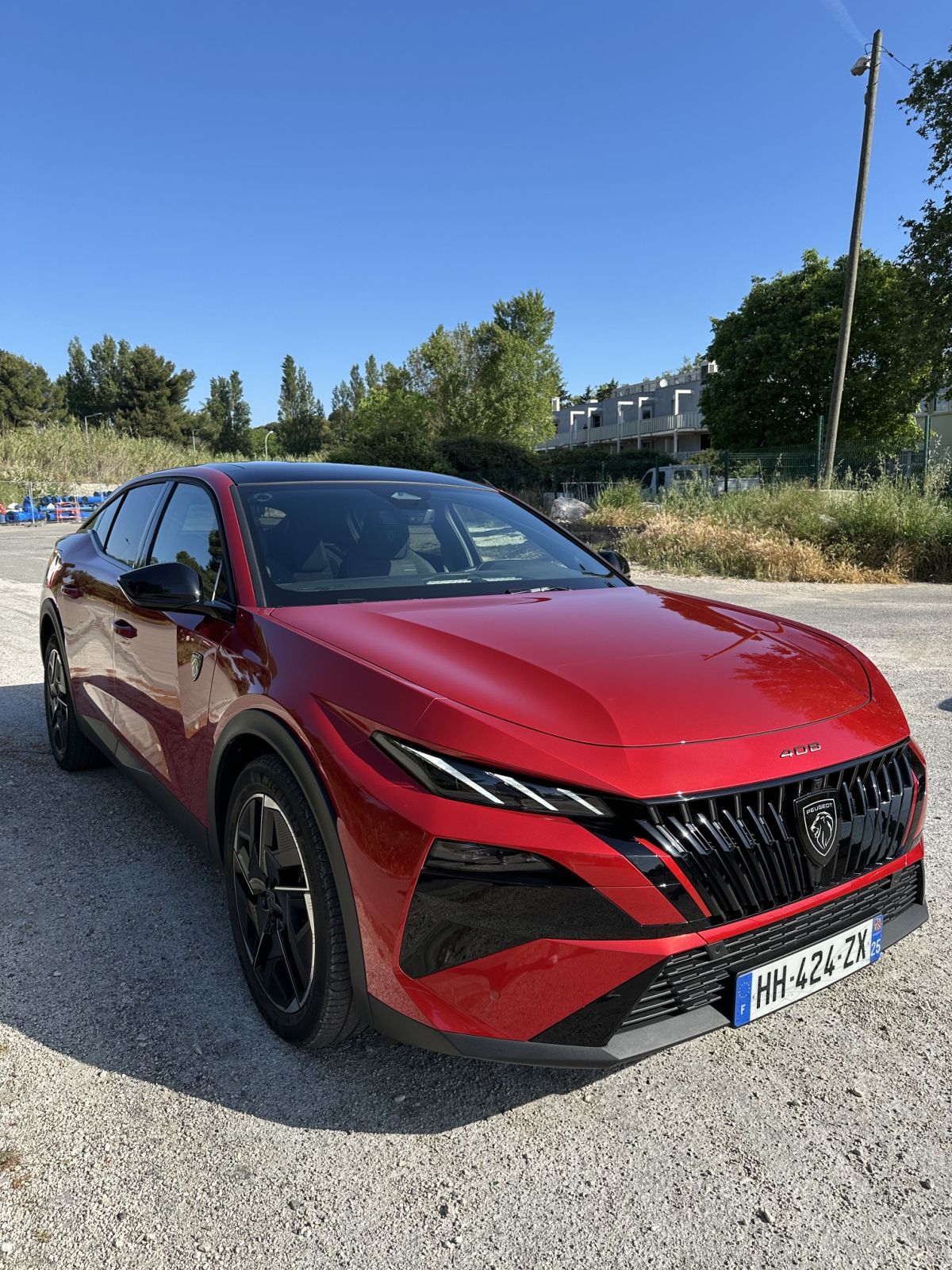
Why we love it:
- Great looking
- Comfy cabin
- Refined
Where it could be better:
- Better electric range needed
- Charging speeds need to be quicker
- Could be even more exciting to drive
Introduction
Peugeot has certainly been turning heads lately.
After years of producing bland, uninspiring family vehicles, the brand has truly upped its game.
Gone are the days of bulbous designs; instead, we're treated to sporty, sleek, and dramatically athletic profiles, along with a notable improvement in interior quality.
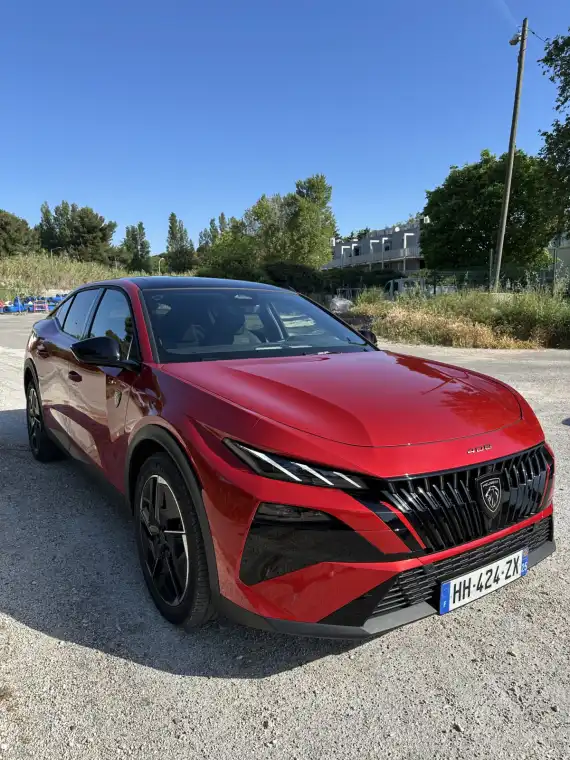
One illustration of this trend is represented by the Peugeot 408, which was launched in 2022, featuring such elements as sharp lines, angular air inlets, and aggressive 'claw' headlights that blend perfectly with the coupe-like 'fastback' body shape.
Now, it's receiving a mid-life refresh that promises to enhance its appeal further.
In case you missed it, just before the facelift was announced, Peugeot introduced an all-electric variant to the lineup, dubbed the e-408.
Mild-hybrid and plug-in hybrid options have been available for a while, but this fully electric model is a recent addition.
As a result, it's undergoing a transformation - and our motoring journalist Tim Barnes-Clay got behind the wheel of the electric version.
So, what's the scoop on all the updates, and is it worth considering this engineless model?
Tim flew to France to find out at the car’s European media drive in Marseille.
The Peugeot e-408 looks fundamentally the same as the pre-facelift model, but there are some noticeable differences.
The front end has been updated by removing the claw-like lightbar that previously connected the headlights to the air intake.
Vertical lines now replace the former horizontal grille design, divided into two rows, with the upper section featuring smaller lightbars.
The air intakes remain, now without the claw, enhancing the vehicle's aggressive look, while the trapezoidal lower grille stays intact, positioned to house the number plate at the bottom.
The headlights have been lowered slightly compared with the previous model.
The side profile maintains its previous aesthetics, showcasing various lines and creases, including a door that appears to wrap around the robust cladding at the base seamlessly.
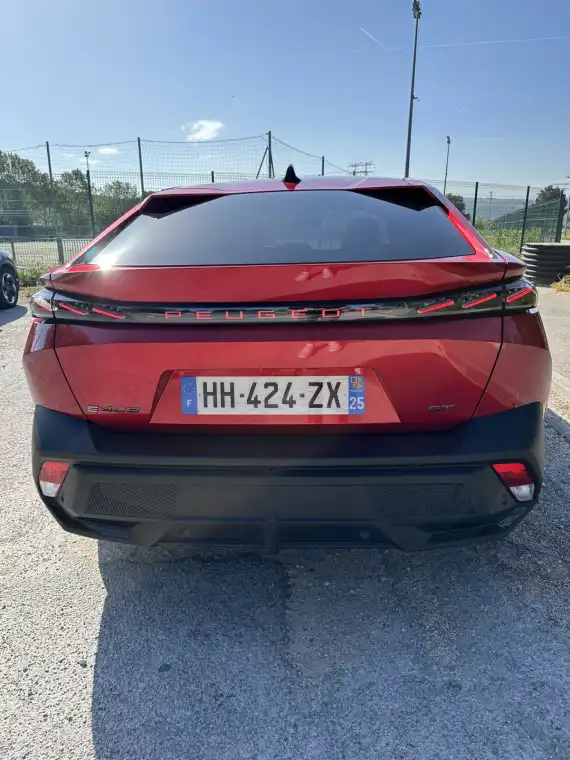
At the rear, the slender taillights remain linked by a lightbar, and the Peugeot name is now prominently displayed within it, replacing the previous badge placement.
The striking, angular cladding extends boldly outward at the lower section.
Overall, it's one of the most visually appealing designs from Peugeot - sporty, muscular, and distinctively unique. When compared with typical generic SUVs, it stands out in a significant way.
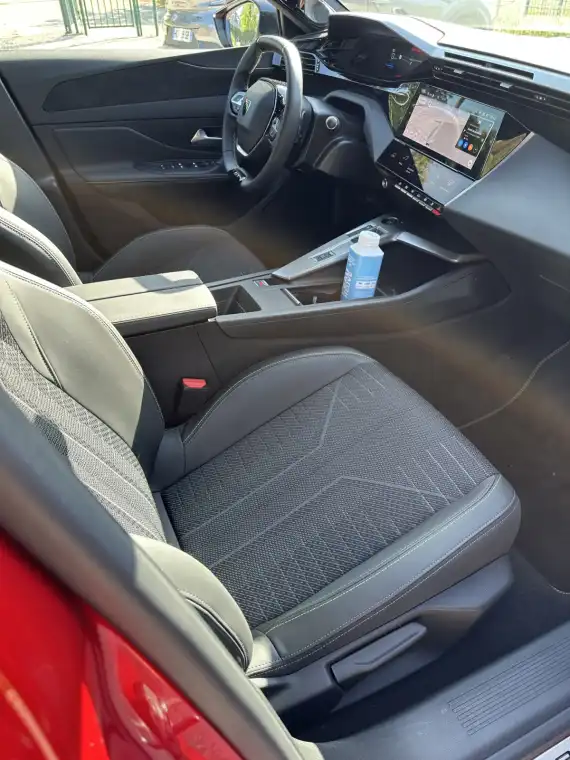
The e-408 is available in three trim levels. The entry-level Allure features 19-inch diamond-cut alloy wheels, a 10-inch infotainment touchscreen compatible with Apple CarPlay and Android Auto, DAB radio, and a 10-inch digital instrument cluster.
You also enjoy automatic air conditioning, Tremezzo grey embossed fabric seats, full LED headlights, a rear-view camera, and keyless entry.
Moving up, the mid-range GT trim includes aluminium sport pedals, Uzila grey embossed fabric seats with green stitching, a powered tailgate, a perforated leather steering wheel, an HR rear-view camera, and an illuminated front grille.
In addition, this trim includes matrix LED headlights, satellite navigation with voice control, and acoustic-laminated front side windows (also available on the Allure in the e-408 mild-hybrid model).
The top-of-the-line GT Premium comes with a 360-degree camera, Alcantara upholstery, a FOCAL premium sound system, hands-free operation for the powered tailgate, a heated steering wheel, a 3D digital instrument display, and a wireless phone charger.
We are particularly focused on the all-electric e-408, which delivers 210PS.
The other models have also seen an increase in power, with the standard 408's mild-hybrid (MHEV) powertrain - a 1.2-litre three-cylinder petrol engine paired with a small electric motor - now producing 145PS (an increase of 9PS) with its six-speed automatic transmission.
Additionally, there's a plug-in hybrid (PHEV) option, housing a 1.6-litre turbocharged petrol unit combined with a larger electric motor, generating 240PS (up from 225PS) with an expanded battery capacity.
On The Road
Handling & Performance
The 210PS from the e-408’s front-wheel drive electric motor moves away pleasingly briskly off the line.
It doesn’t throw you back into your seat like many EVs, instead preferring to reign in the power more smoothly, but a 0-62mph time of 7.6 seconds is more than adequate.
By comparison, the PHEV, despite its 30PS power advantage and 40kg lighter kerb weight, only manages to do it a tenth of a second quicker, while the 145PS MHEV version takes 10.2 seconds.
The electric model’s acceleration continues effortlessly all the way up to motorway speeds and, even then, it feels like there’s more left in reserve, so joining via entry slip roads and overtaking when required leaves it untroubled.
Around town, it doesn’t feel excessive, though its size means it’s not the most convenient car when tackling sharp turns of urban backstreets.
Ride comfort is impressive, too, feeling much softer than its aggressive looks and angular cabin details suggest.
As a result, it makes light work of ironing out bumps and potholes, though poorly maintained roads and rougher surfaces can make the French car feel a little bouncy, taking time to settle back down again.
That means it’s very relaxing to drive - indeed, the soundproofing in the cabin is among the best I’ve come across, with the whine of the electric motor barely noticeable at times.
It is especially impressive in the GT test car, which, along with the top-of-the-range GT Premium model, gets laminated front windows to help deaden the sound - you also get this on entry-level MHEV models.
Soft suspension setups rarely produce exciting cars, and the e-408 isn’t particularly entertaining to drive. However, it nevertheless performed admirably on the test drive in France, resisting body lean around faster bends better than expected.
The steering weights up nicely and feels responsive with decent levels of feedback through the wheel. With that smooth power delivery, it rarely feels like you’re anywhere near approaching its limits unless you’re being truly irresponsible.
It doesn’t handle brilliantly - rather, it carries its weight with dignity.
Regenerative braking has four levels of ferocity, adjusted by pulling paddles behind the steering wheel. Although the highest setting isn’t quite powerful enough for one-pedal driving, the braking force feels intuitive and consistent.
Space & Practicality
The e-408 is undeniably practical in terms of its dimensions, though the sloping roofline means it isn't as spacious as a typical estate car.
That said, there's ample room for two occupants in the front, offering plenty of legroom and headroom, as well as sufficient elbow space to prevent any unwelcome shoulder nudging from your neighbour.
If you're in the driver's seat, finding a comfortable position is fairly straightforward, with extensive seat and steering wheel adjustments available, though manual adjustment is the only option. The GT Premium model, however, features electrically adjustable seats with four-way powered lumbar support.
In addition, the GT Premium variant comes with upgraded front seats certified by AGR (Aktion Gesunder Rücken), a German organisation promoting healthier backs. However, the non-certified seats in the GT remain quite comfortable.
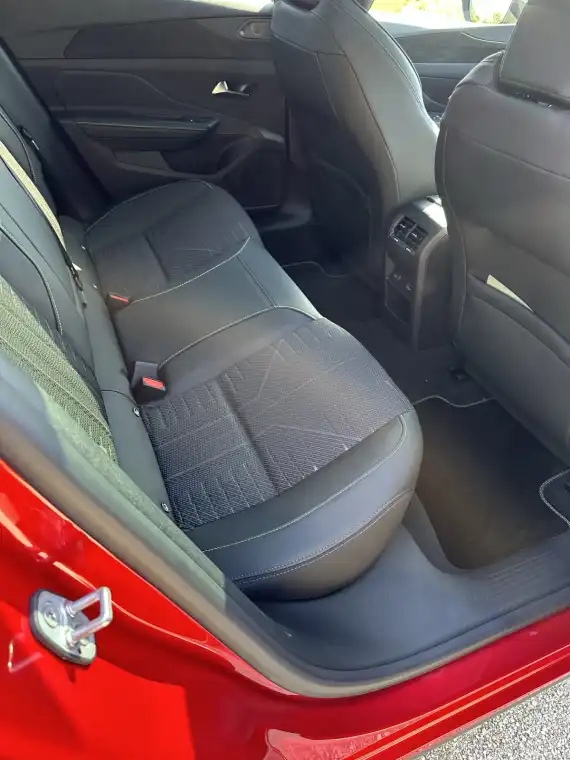
The rear space mirrors this comfort, with ample legroom even when backseat passengers are seated behind taller front occupants. Despite its considerable length of just under 4.7 metres, the sloping roofline results in a loss of headroom compared with smaller family hatchbacks, but it still offers enough space even for taller individuals.
The middle rear seat is less generous in size, yet it will accommodate two adults with a child seated between them, though three grown-ups in the back may find longer journeys uncomfortable.
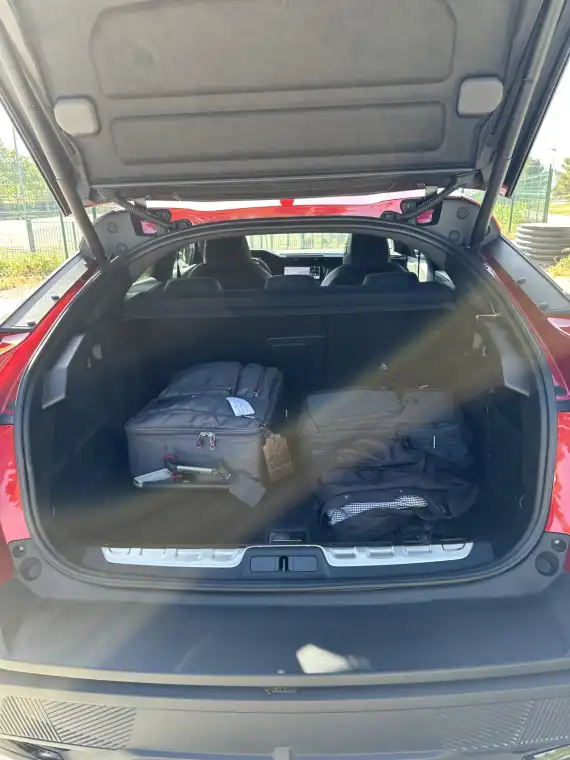
The boot capacity is 471 litres, comparable with the Skoda Elroq and Kia EV4 Fastback. The PHEV version of the 408 retains this capacity, while the MHEVs offer an additional 65 litres. However, all versions will lose 20 to 30 litres if equipped with the Focal premium sound system, which is standard on the GT Premium.
With the rear bench folded 60:40, the capacity increases to 1,545 litres (1,611 litres in the MHEV), although some rivals provide a more flexible 40:20:40 configuration.
While the boot is relatively shallow due to the sloping roofline, it’s very accessible, featuring a minimal loading lip.
There is also a reasonable amount of cabin storage, including a suitably sized glove compartment, large door bins, four USB ports, four cupholders, and a 12V charging socket in the front. However, you'll need to opt for the GT Premium model to get a wireless charger.
Ownership
Running Costs
The Peugeot e-408 is equipped with a 58.2kWh (usable) battery, which remains unchanged from the pre-facelift version. It offers a slightly improved range of 283 miles, although several competitors can travel further.
Charging for the e-408 can reach a maximum rate of 120kW DC, which is less competitive than rivals like the Kia EV6 and Tesla Model 3. Nevertheless, a 20-80% fast charge can be completed in about half an hour.
Using a 7.4kW AC home wallbox, a full charge from empty will take just under 4.5 hours. All e-408 variants support up to 11kW AC charging, although many UK households may not be able to take advantage of these higher speeds.
The e408's running costs will be quite low, especially given rising fuel prices. It is a particularly appealing option for company car drivers, too, as there are Benefit-in-Kind tax incentives for those who opt for electric vehicles.
While road tax is less favourable for EVs than in the past, the first year costs just £10, reverting to the standard £200 annual rate thereafter.
Interestingly, the e-408 is priced lower than the PHEV, coming in at under £40,000, though keep in mind that the threshold for EV supplements has been increased to £50,000.
On the reliability front, Peugeot has climbed in the rankings in recent years and provides reassurance with an eight-year/100,000-mile warranty. However, it’s service-activated, meaning it requires maintenance by a Peugeot-approved dealer to remain valid.
Verdict
The 2026 Peugeot e-408 stands out as a remarkable vehicle that checks numerous boxes.
While it may not deliver the most thrilling driving experience, and its coupe-like 'fastback' design doesn't offer the practicality of a true SUV, it's certainly a head-turner.
Inside, the comfort is delightful, and despite the sloped roofline, cabin space remains surprisingly spacious. Plus, it's priced quite reasonably compared with its competitors.
It operates quietly and feels exceptionally refined. It is arguably the most polished Peugeot I've driven.
True, the charging speeds and range may not be groundbreaking, but they should be adequate for most users.
I recommend opting for the GT model, which comes with a wealth of standard features. The entry-level Allure is also a solid choice, while the GT Premium adds some extra luxuries.
In summary, this is a very impressive car that offers excellent value for money - Peugeot has elevated its game to a whole new level.